




Black Rhino Conservation in Namibia and the Launch of BRAN
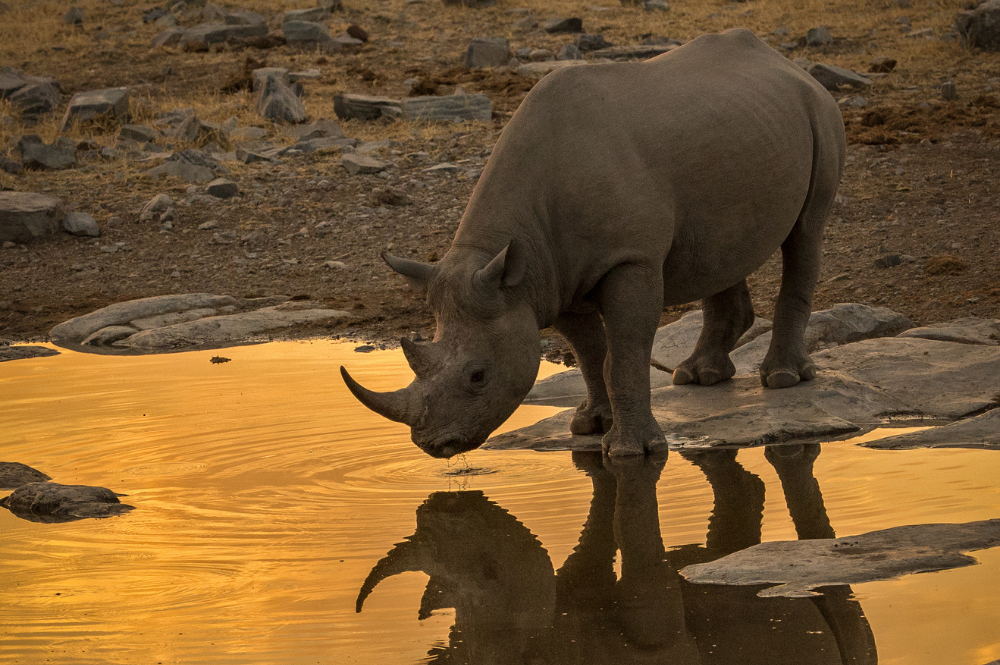
Across Namibia’s vast, arid landscapes, black rhinos can be found in places that, at first glance, might seem far too harsh to sustain them. The fact that they continue to persist here is not just testament to the remarkable adaptability of this species, it is the outcome of decades of strategic conservation decisions and interventions.
The History of Black Rhino Conservation in Namibia
Before the beginning of the 20th Century, black rhinos roamed extensively across Namibia with populations in the north-west of the country remaining numerous during the first half of the Century.
By the 1960s however, this had changed and the Government took the decision to translocate some of the most vulnerable rhinos from these populations east to the protected bounds of the Etosha National Park. Whilst the rhinos thrived and proliferated in Etosha, from the 1960s to 1980s, a combination of extensive droughts and poaching caused the decimation of the species’ free-ranging population in the Kunene.
Further introductions to state protected areas such as Waterberg Plateau Park ensued, but as these populations grew, the limits of park-based protection remained apparent. Black rhinos would need more landscapes with suitable, secure habitat made available to them.
Community-Based Black Rhino Conservation in Namibia
During the same period, Namibia initiated a pioneering community-based approach to conservation which remains foundational today.
In the north-west of the country, a game guard system was established, where community members were appointed by their Traditional Authorities to receive a small wage for monitoring wildlife. This game guard system was supported by the new Integrated Rural Development and Nature Conservation (IRDNC) initiative.
Save the Rhino Trust (SRT) assumed the role of monitoring the Kunene and Erongo Region’s rhinos by employing local rhino trackers. These steps were key to the development of communal conservancies, promoting the management of wildlife on community land and Namibia’s visionary community-based natural resource management programme (CBNRM).
Namibia’s Black Rhino Custodianship Programme
In April 1993, at a point when black rhino numbers across Africa had fallen to critically low levels, Namibia founded the Black Rhino Custodianship Programme.
The principle was straightforward: custodians would hold rhinos on behalf of the country, extending conservation responsibility into working landscapes. It began with a small number of translocations onto private land, including commercial farms, under formal agreements between landowners and the state.
In 2005, the Programme was expanded to incorporate communal conservancies too, empowering those communities living in these landscapes with the potential revenue derived from rhino-related tourism.
Black Rhino Population Growth and Conservation Success in Namibia
Over time, rhino numbers increased steadily, and Namibia became one of the few countries where some of its black rhino populations were able to persist and grow in number outside of designated protected areas. Today, Namibia’s community conservancy land supports the only free-ranging black rhino population of its kind, sustained through long-term partnerships between communities, government, and conservation organisations.
Rhino conservation has generated employment, tourism income, and a practical incentive to maintain wildlife on landscapes that might otherwise have shifted entirely to livestock. The progress has been built on careful biological management and long-term commitments from custodians. Through translocations, monitoring, and sustained protection efforts, Namibia has maintained positive population growth.
The Challenges Facing Black Rhino Conservation in Namibia
But the conditions that historically supported this recovery are changing. Poaching remains a persistent and evolving threat with protection costs subsequently rising, particularly in remote areas where monitoring stretches across vast distances. Recurring droughts are adding further pressure, as custodians balance the needs of wildlife with livestock and other land uses. Tourism fluctuations and rising costs have reduced the financial flexibility of many custodians.
At the same time, state-protected areas have limited capacity to absorb additional animals. The long-term security of Namibia’s black rhino population, therefore, depends heavily on the continued participation of private and communal custodians, bringing both strength and vulnerability to the system.
The Black Rhino Association of Namibia (BRAN)
It is within this context that the Black Rhino Association of Namibia (BRAN) has been established. For more than three decades, custodians have worked through individual agreements and site-based arrangements, often facing similar challenges without a shared platform for exchange. Whilst effective, this has left much of the network operating in parallel rather than together.
BRAN will address this, providing a formal platform to share experience, link sites more effectively, and strengthen the custodians’ roles in national conservation planning. In practice, the Association is intended to strengthen self-reliance by giving custodians a stronger collective voice, while still respecting the independence of individual sites.
Alongside this, it will support practical capacity on the ground, from training and skills development to access to the equipment needed for monitoring and protection across often remote and demanding landscapes. A key part of BRAN is to improve how information moves through the system.
By bringing together data on rhino movements, health, and population trends, BRAN will help ensure that decisions are based on a clearer and more connected picture, particularly when responding to poaching pressure and other environmental stressors.
The First BRAN Annual General Meeting in 2026
Excitingly, the Association held its first Annual General Meeting during May 2026. Key representatives were in attendance, including personnel from the Communal and Freehold Custodians, Namibia Nature Foundation, WWF Namibia, Save the Rhino Trust, Ministry of Environment, Forestry, and Tourism (MEFT).
The Future of Black Rhino Conservation in Namibia
BRAN is a natural step forward in a programme shaped by decades of practical conservation across some of Namibia’s most demanding landscapes. It builds on what already exists, strengthening the systems that support protection, monitoring, and long-term management.
Congratulations to Namibia on reaching this milestone.