


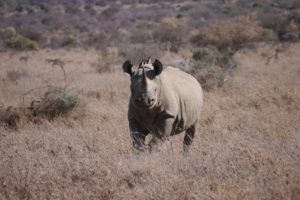


Paws on Patrol: How detection dogs are protecting rhinos
Hours after someone has passed through the bush, their scent still lingers. We’d never notice it, but to a well-trained tracking dog, it’s a trail waiting to be followed. From tracking suspects to detecting firearms and illegal wildlife products, these four-legged friends have become integral members of the rhino protection units. And thanks to your support, the dogs we fund have had a busy first half of the year.
Funding detection dogs to protect rhinos across Africa
In March 2026, we awarded £55,500 in grants to canine units at three key sites: Hluhluwe-iMfolozi Park (HiP) in South Africa, Lewa Wildlife Conservancy in Kenya and North Luangwa National Park in Zambia. Each unit received a grant of £18,500, raised through the 2025 Big Give Christmas appeal. If you donated to this appeal, this is your impact. So, a huge thank you from the dogs, their handlers, and the rhinos they work to protect and the communities who benefit from their work.
How do detection dogs help protect rhinos?
A skilled tracking dog can follow a trail across rough terrain and relocate a lost track in seconds, making canine units one of the most valuable resources rangers have at their disposal.
Across all three sites, the canine units were formed to strengthen the protection of black and white rhinos in high-priority landscapes. These areas offer everything rhinos need to roam, feed and breed, making them critical not only to the species’ survival, but to their ability to thrive. By conserving rhinos here, the dogs and their handlers are helping to secure the long-term recovery of these populations.
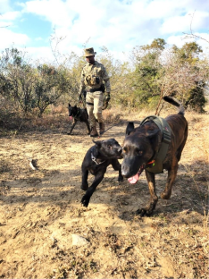
Hluhluwe-iMfolozi Park, South Africa: Improving rhino tracking
HiP is home to one of Africa’s most important rhino populations. Organised crime, which drives the illegal killing of rhinos and the trafficking of their horns, remains one of the biggest threats they face. But there are signs of progress. In 2024, the park dehorned its entire black and white rhino population, and it continues to carry out annual maintenance dehorning. Poaching incidents have since fallen from 198 in 2024 to 63 in 2025.
Leading HiP’s canine unit is Mafu, the primary tracker, alongside Chief and Captain. Two puppies are also in training to join the team, further cementing the unit’s strength and resilience for the future.
This year, they also welcomed a new Unit Coordinator, Tristan Patrick, whose role is funded by Save the Rhino. Tristan has breathed new life into the unit with an improved training structure, and the results are already showing: Mafu, who can follow a scent up to 30 hours old, can now pick up a lost track in just 90 seconds – down from an average of between three and 15 minutes.
So far in 2026, the unit has been deployed 12 times, and the dogs were directly involved in three arrests. These arrests would not have been possible without the dogs – proof of just how vital these highly skilled companions are to safeguarding rhino populations.
Lewa Wildlife Conservancy, Kenya: Keeping rhino patrols moving
At Lewa, the canine unit picks up where helicopter patrols leave off. Following trails on the ground to resolve incidents that can’t be solved from the air alone. Our funding supports the unit’s deployments and operating costs, including vehicle costs so the team can reach incidents quickly, as well as supporting the handlers themselves.
This year has been one of change. After eight years of loyal service, Ruby is preparing to retire, and a new tracker, Lina, has arrived to take her place. The handover was planned rather than reactive: by bringing Lina in while Ruby was still on duty, the team managed to keep tracking going without any gaps. A real testament to the team’s dedication and commitment on the ground.
“Lina has settled in faster than we expected. She’s already out on patrol with her handler, and having a young, energetic dog alongside Ruby has meant we haven’t lost a single day of canine coverage during this transition.”
Edward Ndiritu, Head of Antipoaching, Lewa Wildlife Conservancy
The unit trains daily and has followed up on ten security incidents so far this year, from petty theft to tracking human scents. Remarkably, Lewa has recorded zero rhino poaching incidents since 2019 – an achievement owed in part to the dogs and their handlers, working in close collaboration with rangers and aerial patrols.
North Luangwa National Park, Zambia: Detection dogs supporting law enforcement
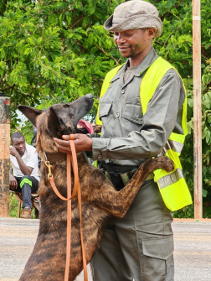
The canine unit is central to North Luangwa’s law enforcement efforts against the organised criminal networks driving the illegal wildlife trade, with dogs and handlers working at roadblocks and on targeted operations. Between January and June 2026, the unit took part in 29 operations, leading to 22 arrests.
Their work goes beyond detection, too: the unit is building long-term operational capacity and strengthening community confidence in wildlife protection.
Now, with two of its dogs, Icke and Valkyrie, retiring, our supporters have provided the funds for two replacements. Finding the right ones isn’t easy – the work demands a very particular aptitude and temperament – and the search is still on for two dogs who will fit seamlessly into the unit. Keeping the unit at full strength means there will be no gap in protection for the park’s black rhinos.
How your support makes a difference for rhinos
At each site, donations have helped to meet a different need: strengthening an established unit at HiP, keeping patrols on the move at Lewa, and securing the funds for two new dogs to join the team in North Luangwa.
And the results speak for themselves. In just six months, these three units have tracked suspects, supported arrests and kept watch over rhinos in some of their most important landscapes.
None of this would be possible without supporters like you.