



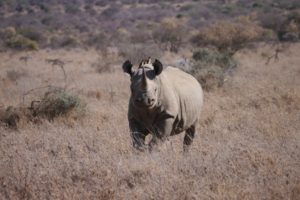


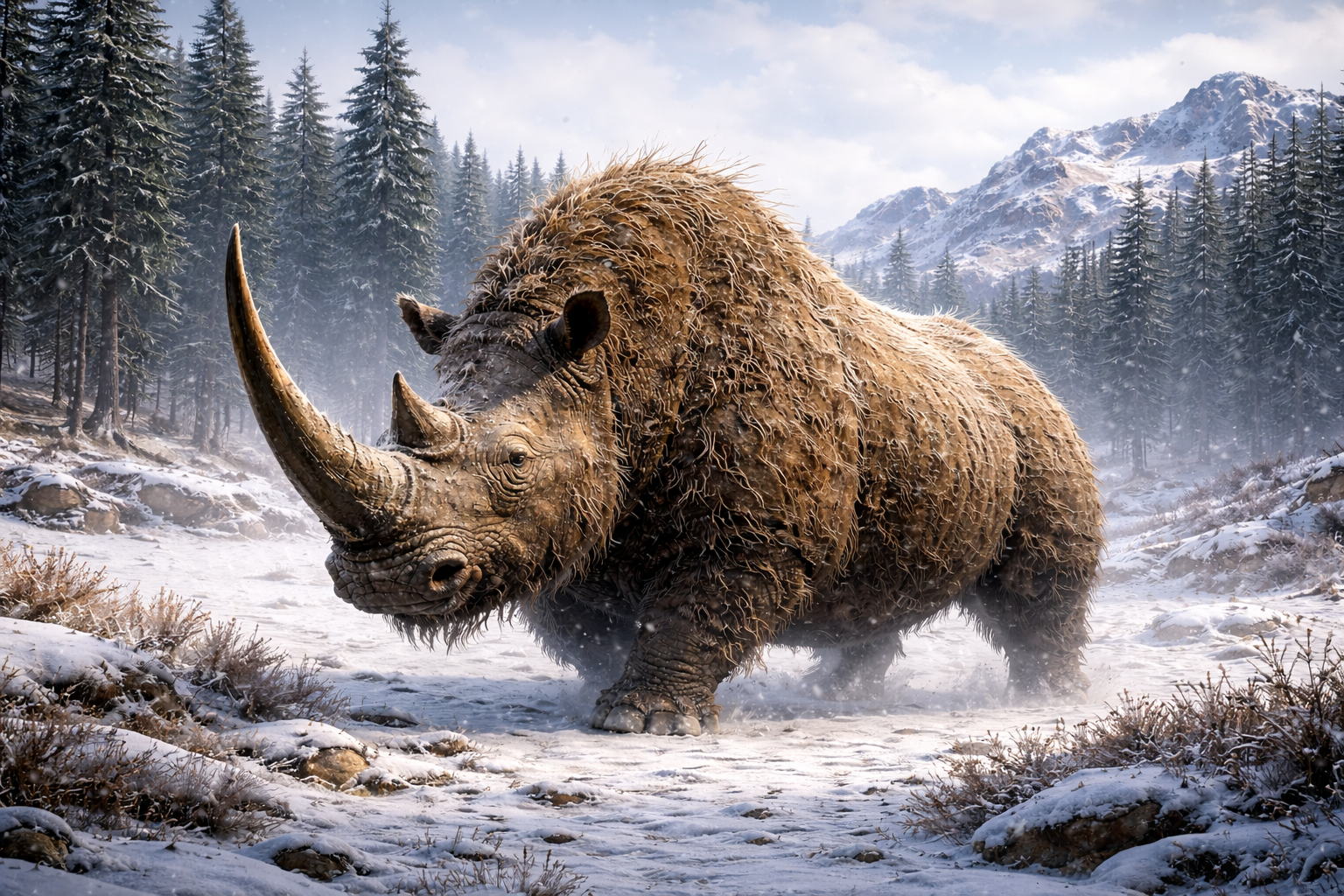
Just five rhino species roam the savannahs, forests and deserts of Africa and South Asia today, with all five either perilously close to becoming extinct, or having been so in recent history and since recovered. But five is a mere fraction of the 250 or so different rhino species identified that once roamed our planet; the most primitive appearing more than 57 million years ago [1,2]. Such variety ranged from Paraceratherium, a species that, at 15-20 tonnes, was one of the largest land mammals ever, to Coelodonta antiquitatis, a species of woolly rhinoceros.
A relative of today’s Critically Endangered Sumatran rhino, this woolly rhino evolved during the Last Ice Age before dying out ~14,000 years ago. With average global temperatures lower and much of the planet’s moisture locked in great ice sheets, sea levels during this period were lower than the present. In fact, there were periods when wildlife such as the woolly rhino could walk unhindered across the mammoth steppe from England to Siberia.
Similar in size to today’s African rhinos, clues about how it lived, looked and interacted with other species have been brought to life in astonishing detail. The thawing permafrost of northern latitudes has revealed the frozen remains of countless species, from woolly mammoths and rhinos to cave lions and bears, many remarkably well-preserved with blood, soft tissues, fur and even their gut contents intact. But one particularly extraordinary find has helped to piece the puzzle together about this question: How did the species go extinct?
More than 14,000 years ago, a wolf pup, having just gorged on morsels, was promptly buried, perhaps in a landslide or a den collapse. Fast forward thousands of years to 2011, when Siberian mammoth-ivory hunters discovered its carcass in the thawing earth. Its remains were then studied, with the autopsy revealing pieces of flesh and characteristic strands of hair still in its stomach. DNA analyses revealed these scraps were from a woolly rhino, perhaps one of the last. Further analyses followed, via which scientists have been able to sequence its entire genome, a first for an ancient species found in the stomach of another.
Incredible as that is, the results paint a surprising picture of the rhinos’ population in the years leading up to its final disappearance. As population numbers become lower, genetic diversity is reduced and breeding between related individuals becomes increasingly likely. This study compared the genome with that of much older specimens, revealing that this was not the case in this instance. Rather, the species showed little sign of inbreeding, surviving for thousands of years in healthy numbers before a sudden event spelt their final demise.
Whether their extinction was due to a sudden shift in climate, human hunting, or a combination of the two remains unresolved. However, exquisitely preserved remains of woolly rhino specimens continue to reveal themselves, including one as recently as August 2024. Time will tell as to whether these hold further clues.
- Kosintsev P., Mitchell K.J., Devièse T., van Der Plicht J., Kuitems M., Petrova E., Tikhonov A., Higham T., Comeskey D., Turney C. & Cooper A. (2019). Evolution and extinction of the giant rhinoceros Elasmotherium sibiricum sheds light on late Quaternary megafaunal extinctions. Nature ecology & evolution. Vol 3(1)
- Bai B., Meng J., Zhang C., Gong Y.X. & Wang Y.Q. (2020). The origin of Rhinocerotoidea and phylogeny of Ceratomorpha (Mammalia, Perissodactyla). Communications Biology. Vol 3(1)