

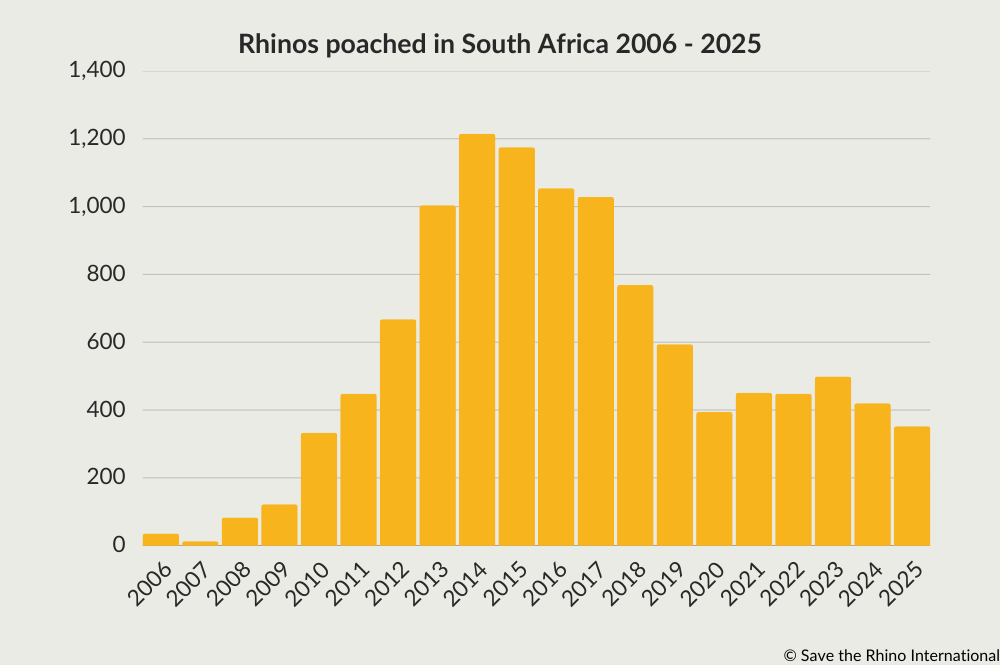
South African Minister of Forestry, Fisheries and the Environment, Mr Willie Aucamp, today announced that 352 rhinos were illegally killed in South Africa in 2025: 266 on state properties, and 86 on privately owned reserves, representing a decrease of 68 animals (or 16%) as compared to 420 rhinos poached in 2024.
It is heartening that the number of rhinos killed in Hluhluwe-iMfolozi Park in Kwazulu-Natal dropped by more than two thirds, from 198 in 2024 to 63 in 2025. The Park has been hard hit by poaching pressure in recent years, and these latest figures show that long-term investment into strategic interventions such as dehorning and camera-trap technology, as well as ranger welfare, can have real impact.
At the same time, the latest figures show that the number of rhinos killed in Kruger National Park nearly doubled from 2024 to 2025, from 88 to 175. This concerning increase highlights the dynamic nature of the criminal gangs responsible for rhino horn trafficking and the ongoing level of threat.
Of the release, Dr Jo Shaw, our CEO, said, “The 68% decline in rhino losses in Hluhluwe-iMfolozi Park last year shows that with support and dedication rhino reserves can become resilient to poaching pressure. However, the doubling of rhino poaching mortalities in Kruger National Park during the same period shows the dynamic nature of the criminal networks and the global threat to these species. Sustainable recovery of rhinos will require transnational investigations along the full illicit supply chains for rhino horns – from rhino range states such as South Africa, to destination states such as China, Vietnam and Laos – and shared commitment to the use of financial and other forensic tools to convict the big players in trafficking networks.”
Minister Aucamp noted the importance of the role of the private sector and the need for holistic solutions. He also emphasised the transboundary nature of these crimes and particularly the role of law-enforcement agencies, such as the SAMLIT Illegal Wildlife Trade Task Force, the Financial Intelligence Centre and the banking sector in disrupting the organised crime networks trafficking rhino horn.
Criminal networks involved in the illegal international trade in rhino horn continue to adapt rapidly, exploiting new transit routes and consumer demand. Any reduction in funding, political will or international cooperation could quickly reverse current gains.
“Behind every reduction in rhino losses are the people on the ground: rangers committed to protecting rhinos, teams of investigators dismantling criminal networks, and communities choosing conservation instead of other land uses and livelihoods. Poaching statistics are more than just numbers; they are an indicator of the cost and fragility of conservation efforts.”